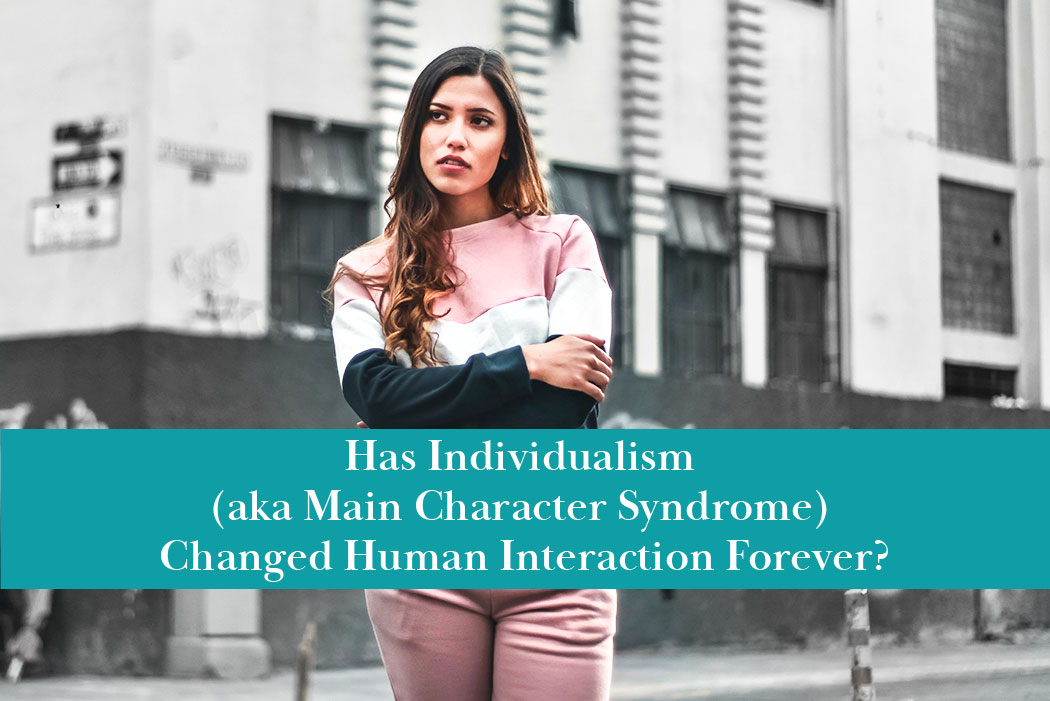
The cashier at my local grocery store stopped, mid-scan and asked her manager if she could take lunch. Half of my order was piled in the bagging area, and the other half sat on the belt un-scanned. Her manager looked at her with disgust. “You’ve only been here 20 minutes, you don’t get lunch yet!: he said. The cashier almost burst into tears. She continued to ring up my order, while complaining to me about the manager’s abuse of privilege. “It’s 11:30, I should be able to take lunch when I need to.” Have people become so immersed in their own individualism that they expect the world to remake itself for them? Are we becoming a hyper-individualistic society, or is this behavior a symptom of something worse?
What is Individualism?
When we’re complaining about a lack of social engagement, or a demand for a “made-to-order” world, we often refer to it as an increase in individualism. But what does that mean? An individualistic perspective focuses on each person within society as a separate entity whose value doesn’t depend on his contributions to the whole. Individualists believe that the interests of the individual should not be subsumed by the interests of the group.
So far, this definition of individualism fits what we’re seeing in society. A decline of interest in, and willingness to, support our neighbors. But that’s not the whole picture. Individualists value independence and self-reliance. But we’re not seeing independence and self-reliance increasing: quite the opposite.
Many of the people who we see distancing themselves from social obligations are the same people demanding accommodations from society. When we want society to change in order to allow us to feel a certain way, we’re not actually individualists. Instead, the pop-psychology term “main character syndrome” is a more apt description.
Main Character Syndrome

While not an actual diagnosis, main character syndrome (MCS), describes well the hyper-self-focused behavior were seeing infiltrate human interactions. Unlike pure individualism, MCS doesn’t just emphasize the worth of the individual — it prioritizes that specific individual’s emotions and wants while dismissing others’ needs.
To give a comparison, an individualist might demand the opportunity to make his own decisions about whether or not to pay into Social Security. Then, he’ll also insist that each individual has the right to make that decision for himself. Someone with MCS might refuse to pay into Social Security, but expects to benefit from other people’s contributions.
A Hyper-Curated Existence Tailored to Individual Demands
Main character syndrome is encouraged on social media, where we can curate our lives, our interactions, and our “stories”. The more time you spend on social media, the greater your need for external validation. From there, it becomes more natural to feel that everything revolves around you.
Social media feeds reward a curated aesthetic and constant self-aggrandizement. The more you display yourself online, the more people see you and interact with your page. And because so many people consider social media a legitimate social interaction, the behaviors they cultivate online begin to trickle down into real social interactions.
In real interactions, curated and “aesthetic” self-portrayal can only exist on a hypothetical stage. Our social interactions become performances in which we are the lead character and everyone else plays a supporting role. Because we are the lead, everything needs to cater to our experience. If we want read a book above our reading level, for example, we may demand for it to be dumbed down so we feel smarter. The goal isn’t self-improvement: it’s self-aggrandizement.
Related Article: Is Everyone a Narcissist Now? How This Therapy Buzzword Became a Popular Label
“Facts Don’t Care…”

A few years ago, a conservative pundit became known for the harsh statement: “facts don’t care about your feelings“. In a way, he’s right. But he’s also an example of the destructive attitude this hyper-self-focus causes in our current social climate. If you’re curating your life to feel important, smart, pretty, real, then you’re failing to address the actual problem. Often feeling important and being important don’t go hand in hand. Focusing on creating a world that feels a certain way can undermine our intentions. To avoid feeling a certain way, we often avoid those situations that allow us to grow.
Self-improvement requires discomfort.
It requires looking at yourself and acknowledging that if you don’t know or understand something, then it’s up to you to pursue that knowledge. It requires you to look at the people around you and see people as being just as worthy of care as yourself. If your choices diminish their humanity, if your interactions reduce them to “supporting cast”, then you’re failing in your own humanity.
And so, if you — like that pundit — are responding to legitimate concerns with similar gotcha-style statements, you’re falling into the same trap. You’ve cast yourself as the clever hero in a culture war and failed to respond to the hard questions the so-called “villains” in your life are asking.
Related Article: Health vs. Free Will – Is the UK’s New Tobacco Ban a Massive Overstep on Personal Freedoms?
The World’s Demands Don’t Support Individualism
It’s easy to look at someone who’s demanding special treatment as the problem, but the same attitude comes creeping out of all of us at some point. Many people ask “why can’t they just make it easier for me?”. Not for everyone, pf course: just for them and their social group.
So how do we step out of this false leading role and back into real relationships? It’s a long journey back, but I’ve found that the best first step is engagement. Smile at the grocery store cashier. Try to actually put yourself in another person’s shoes.
Here’s an example: a few years ago, my car started stalling out at stoplights. It always took me a minute to get it going again when the light turned green. Those moments changed how I reacted to other drivers in turn. Maybe the guy gunning his engine next to me is trying to keep his truck from stalling (it sometimes worked for me!). I started writing little stories in my head, with the chain-smoking, Sean Hannity-listening, engine-gunning guy in the next lane as the hero. What is his inner life like? What beautiful things does he notice that I don’t?
We can still embrace the worth of the individual, but we need to remember that each of us is an individual of infinite value.