Beninese scientists found a living coral garden off West Africa that surveyors dismissed 60 years ago. In the 1960s, a reef off the coast of Benin was recorded in a brief note and then written off as dead. Researchers working from fishing boats on a $20,000 grant have now found it alive, with fish sheltering among its corals. A small team of Beninese scientists accomplished this with only borrowed fishing boats and a modest grant.
This finding is the first documented evidence of living, low-light coral communities on the Gulf of Guinea’s continental shelf, according to Smithsonian Magazine. The team published its results in July in the journal Frontiers in Marine Science.
A Footnote About the Reef in a 130-Page Report
In 1963 and 1964, French researchers surveyed the seabed off what was then Dahomey, now Benin, as well as neighboring Togo, at the request of both governments, Earth.com reports. They worked only from dredge hauls and sound readings, with no cameras, and concluded the coral they found was dead.
The surveyors weren’t even intending to study coral.
According to Inside Climate News, they were hired by local governments to assess fish diversity and find seabeds suitable for trawling. They pulled up heads of coral in their nets, but the find was buried in a short paragraph of a 100+ page report.
No coral research on Benin’s shelf followed, Earth.com notes, so the reef’s extent and condition remained unknown.
Inside Climate News adds that the same report mapped a possible coral barrier about 24 miles long along Benin’s coast.
Over the following decades, local scientists lost track of exactly where it lay. By then, global reef cover was shrinking. The Natural History Museum reported that more than half of it has been lost since 1950, and local oceanographers assumed any remnants off Benin were gone too.
Related Article: COP30 Climate Change Conference Results – The Good, the Bad, and the Hopeful
A Question From Cape Verde
Then Gérard Zinzindohoué, an oceanographer at the Benin Fisheries and Oceanological Research Institute, decided to check.
After seeing coral for the first time in Cape Verde in 2021, he asked himself whether Benin had reefs of its own. A colleague then passed him the old 1960s report.
“I realized how little we know about our own coastal environment,” he said.
Zinzindohoué led the resulting project, called Coral Reefs Rediscovering & Exploration in Benin (COREB). A string of failed grant applications stalled the work for years. But in January 2025, he finally secured a $20,000 National Geographic Explorers grant.
Fishing Boats, Engine Trouble and Nausea
The money didn’t make the fieldwork easy. The sonar equipment accounted for almost 80 percent of the grant. Furthermore, the purchase nearly fell through when the European supplier refused to accept payment from Zinzindohoué’s African bank account.
Benin also has no permanent research vessel. The team used small fishing boats to travel roughly 14 miles offshore and jury-rigged a wooden pirogue to tow the sonar.
Zinzindohoué described the trips as “risky for everyone,” since the boats weren’t built for that distance. His team contended with repeated engine failures and months of seasickness before the sonar returned two strong echoes from the seabed.
Between April and December 2025, the team combined sonar mapping, underwater drone surveys, and stationary video recorders.
Frontiers reports the sonar covered 11.5 kilometers of seabed, guided by the old surveys. National Geographic then sent a high-resolution Deep Sea Camera System from its Exploration Technology Lab to examine what the sonar found.
Related Article: Good News! Green Sea Turtles Are No Longer Endangered
“Everything Was Alive”
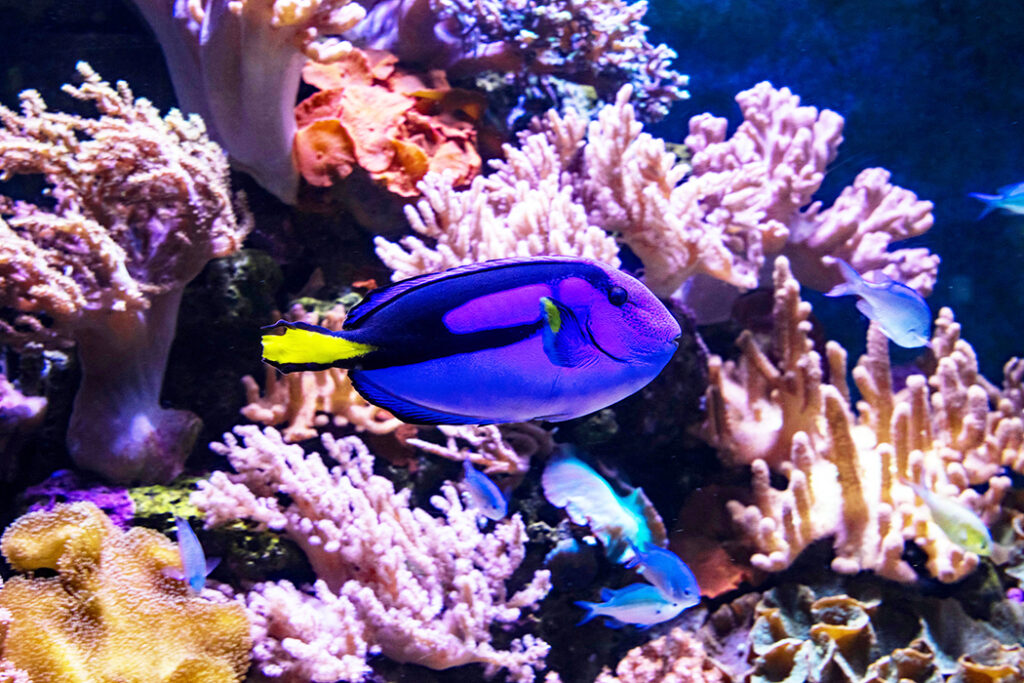
The footage showed a living community with eight types of coral and eight fish species. There were golden African snappers, blackbar soldierfish, Guinean angelfish, West African goatfish, Monrovia doctorfish, three-banded butterflyfish and two species of damselfish. The corals include six soft coral types and two black corals.
Zinzindohoué called it a “really undisturbed environment” and said, “everything was alive.” He said it was a big moment because of things the team had never seen before.
The site is a mesophotic coral ecosystem. These live in deep, dim waters, in this case about 177 feet down. Additionally, they often form scattered patches rather than one continuous structure.
Turns out the Benin site is patches of coral on rocky ground suited to their growth, not an unbroken barrier. NOAA notes that scientists suspect mesophotic corals could help replenish degraded shallow-water ecosystems because the two share species.
What Scientists Still Don’t Know
The team is cautious about what comes next. The researchers haven’t yet taken physical samples of the corals, so the species still need to be verified. Further data could also show whether the corals recorded in the 1960s really were dead and later recovered, or whether the original assumption was simply wrong.
Luiz Rocha, curator of fishes at the California Academy of Sciences, wasn’t involved in the study. He says its main significance is confirming the presence of living mesophotic coral communities in a region where almost nothing was known about them.
He called the Gulf of Guinea a major knowledge gap for both deep and shallow reefs. Many questions remain about the extent and diversity of the corals, he said, and he recommended broader surveys of the shelf.
Related Article: This Year’s Record-Breaking “Super El Niño” Weather Event May be Devastating
Protecting the Reef
Conservation plans are already underway. Midinoudewa, who studies sharks and rays, says his team will push for full protection of the site, possibly through a marine protected area.
He’s also applying for it to be designated an Important Shark and Ray Area by the International Union for Conservation of Nature. Based on local fishermen’s knowledge, he’s confident the area is home to sawback angel sharks, silky sharks, brown skates, and marbled stingrays.
Protection may matter because trawl gear works Benin’s shelf along the bottom. The site may also have scientific value. Zinzindohoué sees the undisturbed ecosystem as a possible source of data on past climate, through carbon dating or paleoclimatic study.
A Bigger Lesson
For Zinzindohoué, the find points to how much is still unmapped.
He thinks the reef is probably not an exception and likely reflects how little is known about coastal West Africa. If it could be found again after 60 years, he asked, how many other reefs remain “undocumented or simply forgotten”?
Earth.com makes the same point, noting that other reefs dismissed in mid-century fishing surveys along the coast may still be down there, intact and unrecorded.
The team also hopes to inspire homegrown research.
“We are the ones who must take responsibility,” Zinzindohoué said.
Coral reef news has been grim for years. As such, finding a reef written off six decades ago that’s actually alive inspires hope. In fact, it offers a brighter potential for the future of climate change and marine life as a whole.
Featured Photo by David Clode on Unsplash