In 1877, a “super El Niño” weather event had catastrophic effects worldwide. The droughts, famines, and heat waves it created led to a global famine that killed 40 to 60 million people worldwide. At the time, that was approximately 3 or 4 percent of the world’s population. If a similar catastrophe happened today, the same percentage would be over 250 million people. According to the NWS and NOAA Climate Prediction Centers, there’s an 82 percent chance of El Niño developing over the summer months. There’s also a 96 percent chance of it developing into a super El Niño by October through December.
What does this mean for life on Earth, both during the event and afterward? And how can people prepare for it?
What is a Super El Niño?
First and foremost, let’s look at what El Niño is.
It’s a climatological phenomenon that forms along South America’s west coast. Essentially, when surface waters in the Pacific are warmer than usual, they lead to atmospheric circulation changes. These in turn affect worldwide weather patterns. Some areas experience extreme drought, while others have record rainfall, leading to flooding and landslides. As you can imagine, these extreme weather events affect everything from weather to agriculture, fishing, and clean water resources.
An El Niño that’s considered “powerful” is one in which the sea surface temperature reaches 1.5C above average. A super El Niño is defined as water temperatures being at least 2C (3.6F) above average over several months. Here’s the bad news: climate scientists are anticipating that this year’s event will exceed 3.0C (5.4F) degrees above normal.
How the 1877 Super El Niño Affected the World: What Can We Expect?
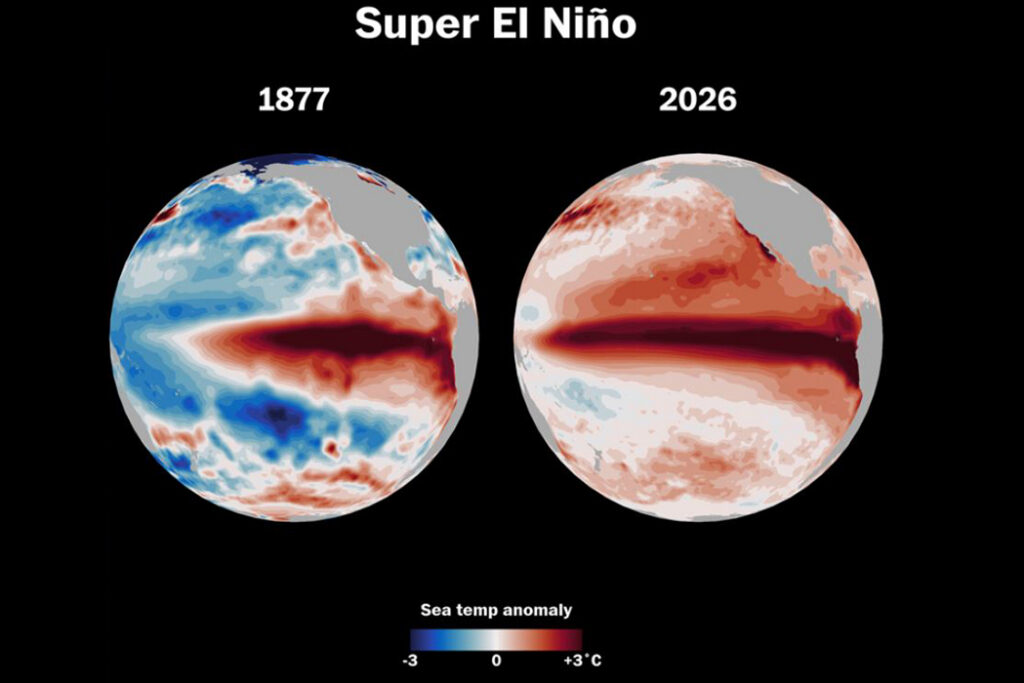
Climatological researchers have said that the 1877 super El Niño was “Arguably the worst environmental disaster to ever befall humanity.” As mentioned, it killed nearly 60 million people worldwide, and countless animals and insects. Droughts and floods caused massive crop failures, leading to widespread famine and disease. These intense weather anomalies affected life on several continents, leading to social crises as well as hunger and death.
We have been seeing intensifying weather patterns worldwide in recent years thanks to accelerating climate change. This has caused the oceans’ temperatures to rise to unprecedented levels. Furthermore, their capacity to absorb carbon dioxide (CO2) is in rapid decline, partially due to microplastics. Last year, the Pacific Upwell failed for the first time in recorded history.
Coral reefs are dying worldwide, and that damage may be irreversible. Additionally, rising sea temperatures is causing widespread mass mortality events in ocean species. Rising heat in the Bering sea has caused a collapse of snow crab populations.
Between food and water shortages, illness and death from heat waves, and disease outbreaks, it’s possible that we’ll be seeing widespread devastation on nearly all continents.
Related Article: COP30 Climate Change Conference Results – The Good, the Bad, and the Hopeful
What Can We Expect for 2026/2027?
The super El Niño that’s developing this year could be even more catastrophic than the 1877 one. If it unfolds as predicted, it’s going to intensify a climate crisis that is already wreaking havoc worldwide.
Prominent scientist James Hansen has predicted that will be the hottest year on record. This prediction has been echoed by environmental scientists worldwide, including those from Canada, France, India, Mexico, and South America. Furthermore, since the full impact of El Niño doesn’t unfold until around Christmastime (hence its name), it will affect weather in 2027 as well.
The countries that are expected to suffer the hardest effects are Central Asia, India, East Africa, and southern North America. South America is set to experience extreme wildfire and drought risk, as are Indonesia and Australia. Ecuador, and other coastal regions of South America will likely be severely affected. A state of emergency has been declared for 14 regions in Peru.
As far as North America is concerned, the Pacific northwest will likely see higher-than-average rainfalls and severe storms. Hawaii is under threat of severe hurricanes, in addition to its recent seismic upheaval. A magnitude 6.0 earthquake hit its Big Island on May 22nd, and the Kīlauea volcano is anticipated to erupt again before the end of the month.
All of these extreme weather patterns affect agriculture worldwide. As a result, we will likely see crop failures in Asia, Africa, and South America. Farmers are already struggling due to a lack of fertilizer thanks to the Strait of Hormuz blockade. With severe weather added to the mix, food shortages are imminent around the globe.
Related Article: Global Food and Water Shortages are Imminent, Experts Warn
How Can People Prepare for a Super El Niño?
Experts are suggesting that if they have the cash to spare, people should stock up on pantry basics. In particular, to pick up items that are grown in areas that are more likely to be affected by extreme weather conditions. These include things like coffee, tea, sugar, chocolate, tropical fruits (canned and preserved), and rice.
Clean water is of the utmost importance. Stockpile bottled water, and keep refillable clean water storage containers on hand. Additionally, water filtration units such as LifeStraw can be essential if potable water sources are tainted by floods.
Heat management is also important. Take note of cooling centers near you, and if you don’t already have an air conditioning unit, consider investing in one. Keep emergency first aid cold packs in your car and bag or purse to use as needed.
Make sure your home, business, and vehicle are insured, and stock up on essential medications.
What Lasting Effects will This Extreme Weather Have on the Earth?
The long-lasting effects of this year’s climate upheaval are certain to be monumental, and potentially even permanent. Climate change is accelerating at a terrifying rate, and recent actions by certain global leaders have seriously damaged the climate change controls that nations worldwide have been striving towards.
For example, the sheer amount of energy created by the AI data centers being built worldwide is creating “heat islands” all around them. These create a cumulative effect, increasing heat over wide areas and impacting global air currents.
The super El Niño we’re expecting this year is going to add even more heat to a world that’s already warming at an alarming rate. If global temperatures rise to (and surpass) 2 degrees Celsius above pre-industrial levels, there will be permanent damage to the entire planet. Not just human inhabitants either, but all life on earth. Existence here is an interconnected web of life, and when some of those strands fall apart, it all collapses.
Increasingly intense weather events such as droughts, floods, hurricanes, and blizzards may obliterate crops worldwide. Melting glaciers and ice caps will increase already-rising sea levels. This will flood coastal cities and contaminate potable water tables.
However things unfold from here on in, it’s unlikely any of us are as prepared as we’d like to be.
Featured image by Javier Miranda on Unsplash