Neuroscience studies about the damaging effects of early childhood trauma on brain development have provided a clear roadmap to significantly reducing rates of homelessness, suicide, substance abuse and mood disorders in populations across the world. In Trauma, PTSD, and the Developing Brain, a study published in 2017 by Ryan J. Herringa, it was revealed that by age 18 around 8 percent of traumatized youths met the criteria for PTSD (Post Traumatic Stress Disorder).
This is significant because PTSD has long since been strongly linked with life-long struggles in individuals. It begins with lower academic achievements in school, as well as substance abuse. In adulthood, it manifests in increased suicide attempt rates and chronic health conditions. What many people might not realize is that this study (as well as several others) has compared imaging of brains that developed under severe prolonged stress to those of brains that developed typically to show the structural differences between the two. We can now see with our own eyes that childhood trauma causes serious neuro-biological harm.
Types of Childhood Trauma that Contribute to Damaged Brain Development
Childhood and Trauma: a Neuroscience Perspective (published in 2024 in OxJournal) defines childhood trauma as severe stressors experienced for prolonged periods. These include sexual abuse, physical and/or emotional abuse, neglect, medical trauma, poverty, wars and even natural disasters. It’s worth noting that the likelihood of a child developing PTSD is exponentially higher among those who experienced abuse in interpersonal relationships, especially where sexual abuse has been experienced.
It has been an enduring cultural belief that children can’t experience PTSD because their brains are far more resilient to stress than adult brains are. Brains have the most neuroplasticity (the ability to learn and adjust learning to experiences) before the age of seven. That said, children’s brains are extremely vulnerable to environmental influences, both positive and negative. Some negative experiences are important for developing brains, as they help to cultivate resilience. An excessive amount of them, however, affects brain processes that can have severe lifelong consequences.
There are three major brain areas that consistently show delayed or impaired development under prolonged severe stress across most studies. These are the amygdala, the hippocampus, and the prefrontal lobe. The damage occurs as a domino effect. Repetitive severe stress causes the amygdala (the emotional and threat processing part of the brain) to become overactive. This triggers the release of excessive amounts of cortisol by the nervous system. Too much cortisol rewires neural pathways. This in turn shrinks the hippocampus (impairing memory) and weakens the prefrontal cortex (impairing focus and impulse control). All of which enlarges the amygdala, causing hyper-reactivity and chronic anxiety. This keeps the release of cortisol coming in a vicious cycle.
How These Functions Affect Our Entire Lives
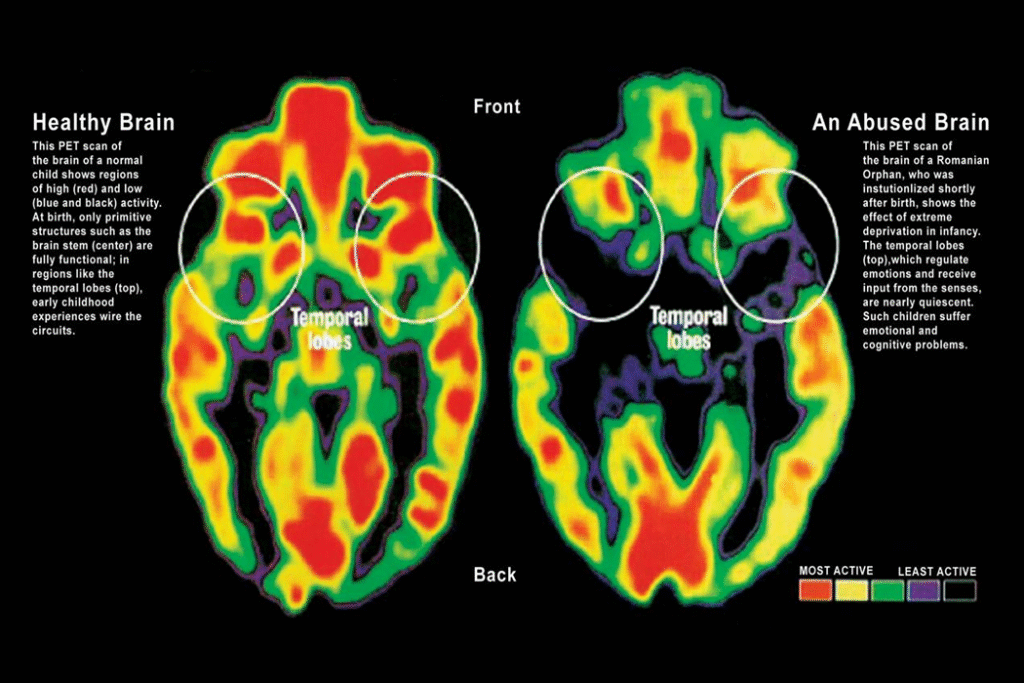
To appreciate how important the findings in these studies are, we have to understand what mental, emotional and physical functions these parts of our brains are designed to perform. It’s also vital to remember that they do not exist in our brain structure completely separate from each other. Instead, they communicate and work with each other through synapses that we start building in our earliest years of life. Let’s break down in real terms what the amygdala, hippocampus and prefrontal cortex control and how that translates into our real lived experiences:
What the amygdala does:
- Detects threats and controls our fight-or-flight responses
- Connects emotions to memories
- Plays a role in social communication and comprehension
- It’s where we learn through rewards and punishments
How trauma to the amygdala affects our real lives:
- It causes hypervigilance to potential threats, chronic anxiety
- It stresses social relationships with emotional reactivity
- It can trigger substance abuse behaviors
- It can cause flashbacks and fragmented memories
What the hippocampus does:
- It converts short-term memories into long term memories
- It’s the brain’s information filing secretary
- Helps with learning functions
- It’s responsible for visual-spacial memory
How trauma to the hippocampus affects our real lives:
- It can strongly hinder learning abilities
- It contributes to emotional dysregulation
- It causes intrusive, missing, and fragmented memories
- Affects your ability to make decisions
What the prefrontal cortex does:
- It controls your ability to focus
- It’s where you develop impulse control
- It’s stores your working memory, which is vital to the learning process
- It’s vital to rational decision making ability
How trauma to the prefrontal cortex affects your real life:
- Makes it difficult to set goals
- Causes serious learning deficits
- Causes more risk taking behaviors
- Problem solving difficulties
How Childhood PTSD Can be Mitigated
It’s clear that the parts of the brain most affected by early childhood trauma are crucial to our ability to function successfully as adults. As bad as the impact of childhood PTSD is, with early detection and treatment of the underlying trauma, a lot of the damage it causes is reversible. If treatment and support are provided before the child reaches adulthood, they can rewire and rebuild a lot of their brain’s connections, improving functionality.
When underlying trauma goes untreated into adulthood, however, they face a lifetime of significantly increased risk of developing symptoms of PTSD like depression, anxiety, and substance abuse. These symptoms compound the likelihood that a person will engage in high risk lifestyles, enter into or create abusive relationships, struggle to keep jobs, become suicidal and potentially become homeless. While there are other causes of people experiencing any number of these difficulties in their adulthood, these scientific studies have proven again and again that the biggest predictor of these outcomes in a person’s adulthood is early childhood trauma.
The hopeful and actionable part of what neuroscience has proven about developing brains and trauma is that there are a number of evidence-based treatments available to children and their caregivers who are struggling with it. There are several different types of treatments to choose from depending on individual needs and situations.
Related Article: How Psilocybin “Magic Mushrooms” can Help to Alleviate Mental and Emotional Disorders
Treatments that May Be Effective

Photo by Birleşim Özel Eğitim Rehabilitasyon Merkezi on Unsplash
Here’s a breakdown of three of the most commonly used treatment modules you can seek for traumatized children:
Trauma-Focused Cognitive Behavioral Therapy (TF-CBT)
- It includes psychoeducation about trauma for parents/caregivers
- Helps develop parenting skills
- Helps children verbalize the traumas they’ve experienced/witnessed
- Helping them process their thoughts, feelings and behaviors
Play Therapy
- direct play is therapist driven, using specific toys to mirror trauma
- Indirect play is child driven, letting the child choose toys
- This therapy is especially useful for nonverbal children
- Creates a safe space promoting confidence in children
- Lets children approach trauma at their own pace
Parent-Child Interaction Therapy (PCIT)
- Uses both parent directed interactions and child directed play
- Strengthens positive parent attention skills
- Improves consistency in appropriate discipline use
- Mastery based rather than time limited therapy
- Assigns play homework to parent/child to practice skills
Additional Approaches to Explore
A few other treatments you can explore are Child Parent Psychotherapy (CPP), Trauma Systems Therapy (TST) and Eye Movement Desensitization and Reprocessing (EMDR). Read about all of the treatment options before talking to your healthcare provider because they may omit options based on their own personal biases. If they don’t offer up a therapy module that you think will be best suited for you and your child (or the child in your care), speak up!
Proving that early childhood trauma profoundly affects brain development proves that early intervention with treatment is suicide prevention, homelessness prevention, and substance abuse prevention. These are all fundamental problems we have in our society today, and while nothing can completely erase any of these issues, the directive is clear: make mental health services accessible and robustly staffed and funded for everyone who needs it.
Featured image by Elena Elena on Unsplash