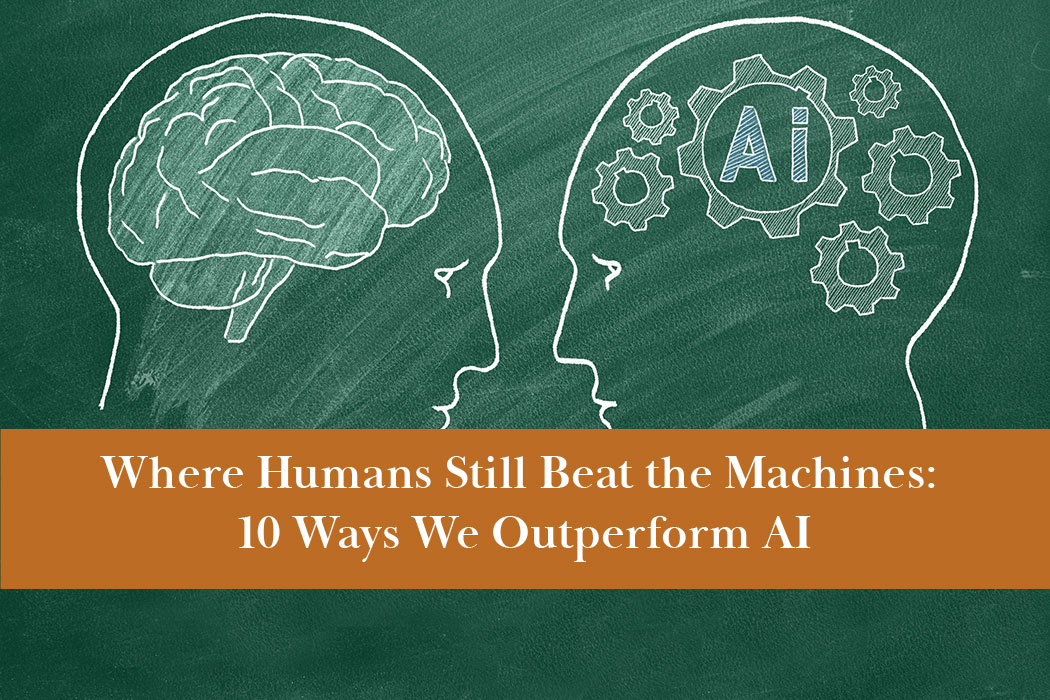
Artificial Intelligence has become the default assumption behind a lot of modern work: ask a question, get an answer, trust the answer — as if it were verified before it reached you. It isn’t. Despite genuine leaps forward, AI still loses to humans in specific, measurable ways.
1. Research-level Mathematics
In June 2026, a project called First Proof gave AI its most rigorous math test yet: ten unseen, research-level problems graded by anonymous human mathematicians. The top artificial intelligence model scored 6 out of 10 — a pass, not a triumph, and short of expert-level work.
FrontierMath, a similarly adversarial benchmark built by professional mathematicians including Terence Tao, saw top systems score under 2 percent at launch in 2024. Even recent gains into the 20-25 percent range leave the hardest research-level tier largely closed to artificial intelligence. In contrast, human mathematicians routinely spend days on exactly those problems.
2. Knowing What You Don’t Know
Humans can say “I’m not sure.” AI tends to answer confidently even when fabricating, a failure known as hallucination.
Here are just a few examples.
Stanford RegLab found chatbots hallucinated on 58-88 percent of questions about federal court cases, and law firms have kept filing hallucinated citations into 2026. Medical artificial intelligence shows 43-64 percent hallucination rates depending on prompt quality, and even 2026’s best frontier models still hallucinate on 3-19 percent of factual tasks.
Related Article: The Rise of AI is Creating A Massive Revival in Analog Media
3. Physical Common Sense

Infants grasp gravity and object permanence within months of birth, with no formal teaching. AI has no such head start.
A 2026 robotics review found foundation models still lack basic physical common sense, making real-world deployment difficult, and the International AI Safety Report notes artificial intelligence “cannot yet integrate with robotic components to perform basic physical tasks such as housework.”
4. Judgment and Adaptability
AI reasoning tends to “degrade exponentially” as tasks require more sequential steps, and even in advanced manufacturing, the cognitive load of managing exceptions still falls almost entirely on human workers.
Humans remain far better at improvising when a plan meets an unexpected obstacle.
Related Article: Using ChatGPT is Dumbing-Down the Population – Here’s How to Maintain Your Brain Power
5. AI Struggles with Cross-disciplinary Reasoning
The mathematicians grading First Proof noted that genuinely novel research requires combining insight across fields in ways current artificial intelligence struggles to replicate.
Likewise, AI models handle code generation well but still perform poorly on architectural decisions and cross-file refactoring — holistic judgment human engineers manage more naturally.
6. Taste and Discernment

AI can generate endless options. But picking the one worth keeping is still a human job.
A study of over four million AI-assisted artworks found the artists who benefited most were those who filtered and curated outputs for coherence — human judgment, not raw generation, drove success.
Another study found professional artists rated highest on originality and aesthetics, while an unguided artificial intelligence model scored lowest of any group tested.
7. AI Can’t Fake Emotional Intelligence
Some studies rate AI responses as more empathetic-sounding than physicians’, but sounding empathetic isn’t the same as feeling it. AI can simulate cognitive empathy but can’t experience genuine emotional concern, since it has no subjective experience.
Research on AI chatbots in education found that they often lack the authentic empathy needed for complex emotional needs, and a 2026 analysis warned artificial intelligence can “simulate empathy while completely lacking care.”
Related Article: 40,000-Acre AI Data Center in Utah Gets the Go-Ahead, Devastating Local Residents
8. Handling Ambiguity
AI is fundamentally a pattern-matcher, and genuinely new situations lack precedent to match.
AI predictions degrade in ambiguous, value-laden decisions, while humans adapt in real time with incomplete information. Compliance research shows AI specifically struggles with edge cases that don’t fit predefined categories, and studies of LLMs handling exceptions found it unclear how these systems weigh trade-offs or generalize to novel contexts at all.
9. Originality At the Top Tier

AI might be able to beat the average person on standardized creativity tests, but it will never be able to beat humans at creative writing, like haiku and short stories, or at art. It lacks lived personal experience, genuine emotion, and conscious intent.
Without the ability to experience love, grief, fear, joy, or struggles, artificial intelligence simply doesn’t have what it takes. These things are what it takes to form true creativity. AI can only imitate what’s already been done rather than invent a completely new perspective.
10. Thriving Under Stress
Humans have a biological relationship with pressure that AI doesn’t share.
Physiological research using ECG and EEG monitoring has found that stress measurably changes how the human brain approaches creative problems, for better or worse, depending on how the challenge is appraised.
When people frame a stressor as a challenge rather than a threat, it can sharpen focus rather than derail it. AI has no equivalent. No adrenaline, no stakes, no consequence — just the same linear computation whether the prompt is trivial or critical.
AI is improving fast, but that’s not the same as flawless. In so many areas (probably even more than what’s included in this list), humans still hold a real, measurable edge. Treating AI output as automatically correct, rather than as a fast first draft that still needs a human check, is a mistake the data backs up.
Featured photo © Yakobchuk, via Dreamstime.com