Last year, my siblings and I gathered for an evening out. We live widely-scattered lives, but when we’re all together, we pick an evening for drinks and conversation: Sibling Fun Night. This time, we sat down at a local micro-brewery with great beer on tap and a welcoming atmosphere. But the menu was a QR code. None of us carries a smartphone. Fortunately, there was a back up menu on a chalkboard over the bar —a throwback to when life was more analog, and less digital.
The Re-Humanization that Analog Experiences can Offer
Supporting small, local businesses is worth a little hassle, but the experience got us talking about life in the digital age. We discussed how AI is being inserted into nearly every aspect of life until, in loneliness and desperation, we start reaching back for something tangible.
Choosing to remain with — or return to — analog media is not without its challenges. From QR menus to stamp prices, the analog experience puts us out of the mainstream. But those limitations are a gift as well. For example, a handwritten thank-you note means far more today than it did before most people started sending “THX” in text with a little smiley-face emoji.
In the past few years, alongside the rise of AI in digital spaces, there’s been a huge revival in analog media. Is it a reaction to AI, or just a nostalgic longing for the “good old days” when music crackled over the radio, pages crinkled in your hands, and everything was a tactile experience?
What Is Analog Media?

Let’s clarify: what’s the difference between analog and digital? And what does this have to do with AI?
An analog item uses continuous variables in the physical world to present information. The clearest example is a clock face, in which the hands move clearly and continuously around the face. You can watch the hour hand moving slowly from 4 to 5 to 6, while the minute hand moves more quickly. If you have a second hand, it’s tick, tick, ticking away continuously. Time follows a pattern around the face of the clock.
Analogs are physical and tactile. The variables in the physical media change and those changes give information. A book or a record has information printed or pressed into the medium. If you scratch out that information, physically, the information is gone.
Digital media, on the other hand, is composed of discreet, coded steps to convey information. The information isn’t tangible: it’s representative and must be decoded to be received. While analog media must be scratched out or rewound to be rewritten, digital media only needs a new code. You can’t cut or edit, you can’t play it backwards: you can only consume it as it’s presented to you.
Analog Media Lets You Get Your Life Back from the Machines

In simplest terms, analog media feels more human. The step-by-step motion of the clock reminds us of how we walk, step by step, through our daily lives. Similarly, the crackle and static of a record or radio offers shifting, sighing, brushing sounds like the background noise of the natural world.
As the digital world becomes further and further from tangible life, our longing for it increases. The clear voice of Alexa or Siri slides into every conversation and we buy white noise machines to imitate the imperfect quiet of nature. We spend more time staring at the dull, blue light of a screen, so we buy red-light glasses for the illusion of artificial warmth. The more invasive AI becomes, the more the human heart hungers for real connection.
It’s eye opening to listen to people describe their journeys back to analog media, saying things like:
“I have my life back.”
“I’m experiencing wonder again.”
“I feel like I’m in control of me again.”
Reading about journeys from an algorithm-driven life to an analog life is inspiring — not only because these people are swimming against the tide, but because they’re enjoying the swim. Quite simply, analog experiences are bringing immense joy to the people who are embracing them. Tangible experiences last. They take root in our memories. Writing notes by hand increases memorization and understanding. Photo albums can be handed down through generations, while the 30,000 selfies on your smartphone can’t.
Related Article: Using ChatGPT is Dumbing-Down the Population — Here’s How to Maintain Your Brain Power
A Different Kind of Recession
Recently, the Financial Times stated that human minds are “in recession“. We’re spending an average of ten hours a day on a screen: either for work or recreation, or just because “it’s there”. Simply put, our screen time is overwhelming us.
Constant information pours in, and if we need to think about that information, AI is willing to do that for us. And all the distractions, alongside increasing reliance on digital answers is straining our minds.
As a result, IQ scores have been falling steadily for decades. Anxiety and depression are skyrocketing. Literary proficiency and analytical thinking are declining, and our attention spans are practically non-existent. In 1960, the average attention span for visual media was about 45 seconds. Now, it’s only eight seconds.
The human mind is sending out distress signs, and craving a return to reality. Analog media feels relaxing because it follows visible patterns that our brains can track. It also keeps our minds working: with analog, we remain connected to the world. We touch, write, move, turn pages, flip records. We think independently and make our own decisions.
Experiencing Wonder
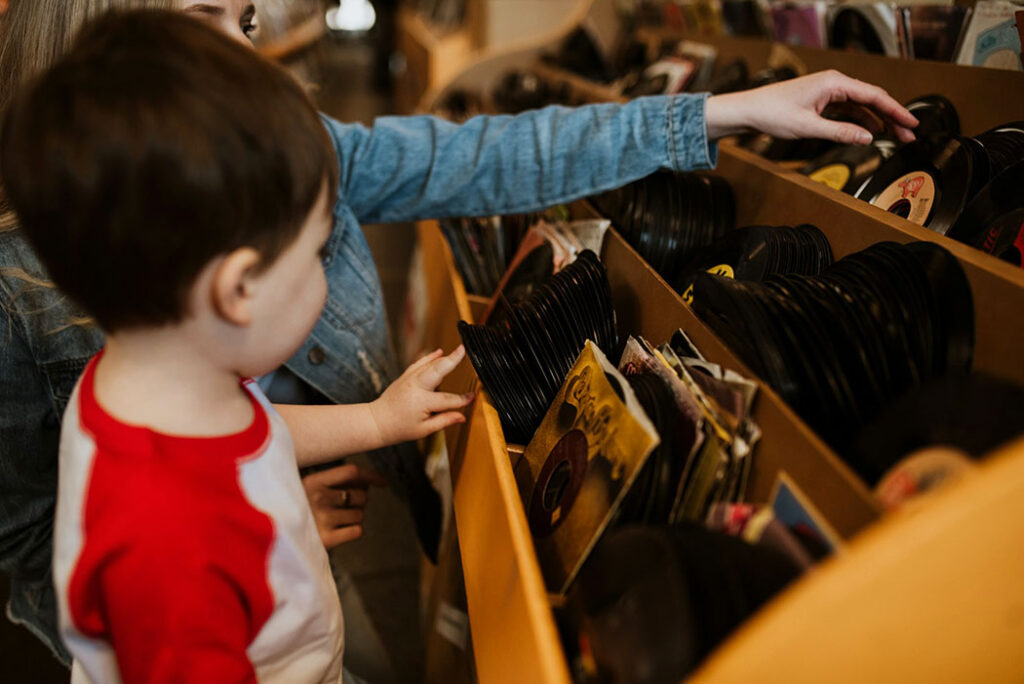
AI inserting itself into art, music, and writing have encouraged people to choose media less likely to lie to them. Is that a recording of real monks chanting, or is it just AI making noises? Is that a real photo of my mom hugging Eminem, or is it another Fake-Bot image?
Looking at a film-photo of a stage in the woods in autumn feels magical. It happened, and an actual person was there to see it. Taking down a book that has someone’s name written in the upper left-hand corner, and reading while sipping your afternoon tea or coffee, connects you to that person in a way that scrolling down “pages” on an e-reader doesn’t. Writing in notebooks, playing your mom’s old Thriller record, or just having a phone that doesn’t do a million things other than call people changes how we look at the world. It reminds us how to look at the beauty around us and actually see it.
Analog media helps to retrain humanity to look with wonder and rediscover the world we share. Instead of merely absorbing what the algorithm feeds us, we can feel human again: we can talk, touch, think, listen.
Quite simply, we can be amazed by everything life has to offer us without stopping to worry whether it’s real or not.
Featured image ©Sebnem Ragiboglu | Dreamstime.com
Additional images by Seven Shooter, Pierre Bamin, and Jessica Scalf, via Unsplash Creative Commons.