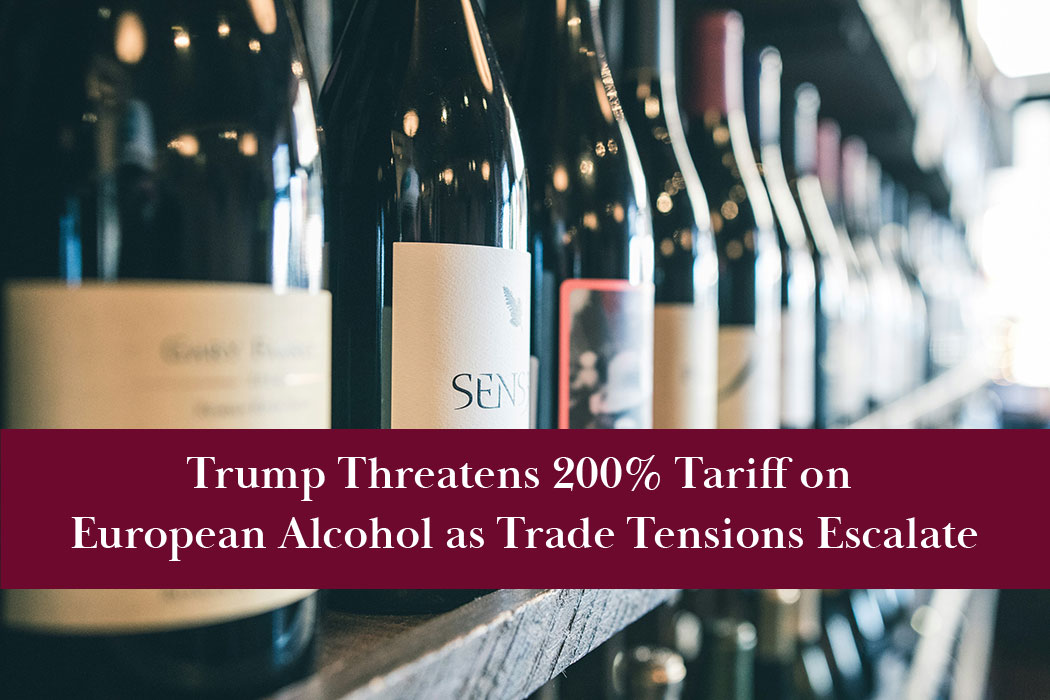
President Donald Trump has threatened to impose a substantial 200 percent tariff on all wines, champagnes, and alcoholic beverages from the European Union. The announcement was made Thursday via his Truth Social platform. This threat comes in direct response to the European Union’s planned 50 percent tax on American whiskey imports. It’s part of a larger EU retaliation package targeting $28 billion worth of American goods. These EU measures are scheduled to take effect in April. They were crafted in response to Trump’s recent imposition of 25 percent tariffs on steel and aluminum imports.
“If this tariff is not removed immediately, the US will shortly place a 200 percent tariff on all wines, champagnes, and alcoholic products coming out of France and other EU-represented countries,” Trump posted, adding that such measures “will be great for the wine and champagne businesses in the US.”
Trump’s Behavior Destabilizes Global Trade Markets
The confrontation has unsettled financial markets. In fact, the S&P 500 dropped nearly 1.4 percent on Thursday, falling roughly 10 percent from its most recent peak. A milestone that market analysts classify as a correction. The Dow slumped 1.3 percent, while the Nasdaq fell almost 2 percent. European markets also felt the impact, with France’s CAC 40 falling 0.6 percent. Shares of major spirit makers like Pernod Ricard and LVMH experienced significant declines.
European officials have responded firmly to Trump’s threats. Laurent Saint-Martin, France’s Minister for Foreign Trade, rejected the American president’s position, stating on X (formerly Twitter) that “France, together with the European Commission and our partners, is determined to fight back. We will not give in to threats and will always protect our industries.”
Related Article: Latest U.S. Import Ban Now Blocks Canadian Dairy and Alcohol
The EU’s Response
European Commission President Ursula von der Leyen defended the EU’s stance, describing the bloc’s countermeasures as “strong but proportionate.” The Commission confirmed that its trade commissioner, Maroš Šefčovič, has reached out to American counterparts following Trump’s latest threat.
The dispute resurrects trade tensions that previously flared during Trump’s first term, when similar tariffs led to a significant decline in American whiskey exports to Europe. According to the Distilled Spirits Council, US whiskey sales to the EU dropped 20% between 2018 and 2021, falling from approximately $552 million to $440 million. Those tariffs were eventually lifted after Trump left office, following an agreement that exempted certain European metals from the duties.
For the European wine industry, the stakes are exceptionally high. Europe exports more than €4.5 billion ($4.89 billion) worth of wine to the US annually, making America the region’s largest export market. Ignacio Sánchez Recarte, secretary-general of the European wine industry association, warned that if Trump follows through on his threats, “it would destroy the market, costing thousands of jobs.”
Related Article: Global Food and Water Shortages are Imminent, Experts Warn
Concerns for American Importers are Justified
American importers of European wines are similarly concerned. Mary Taylor, who imports 2 million bottles of European wine yearly, called the proposed tariff “a giant threat to our livelihoods.” She managed to weather the previous 25 percent tariff during Trump’s first term by expanding distribution in Europe. But she cautioned that “200 percent is a whole different ball game.”
White House officials have placed blame for the escalation on the European Union. Commerce Secretary Howard Lutnick questioned why Europeans were “picking on Kentucky bourbon or Harley-Davidson motorcycles,” calling it “disrespectful.” Treasury Secretary Scott Bessent dismissed market concerns about the dispute. He suggested that a trade war would likely inflict more economic pain on the EU than on the US.
Some analysts believe the confrontation will eventually lead to negotiations. Former Trump adviser Stephen Moore, now with the Heritage Foundation, predicted: “Absolutely, this is going to end up with a deal. It’s only a question of whether it ends up in a deal in a day, a week, a month or six months. But there will eventually be a negotiated settlement.”
In the meantime, European Central Bank President Christine Lagarde warned in a BBC interview that “everybody will suffer” if the dispute develops into a full-blown trade war. Though she expressed hope that the two sides would eventually sit down to negotiate.
Featured Photo by Scott Warman on Unsplash