The population of Americans diagnosed with neurodivergent conditions is growing steadily. In the past 20 years, the number of people diagnosed with Autism Spectrum Disorder (ASD) has increased over 300 percent. The number of people diagnosed with Attention Deficiet Hyperactivity Disorder (ADHD) has almost doubled in that same time. Neurodivergence can feel overwhelming to parents when their child is first diagnosed. Even more so when that diagnosis is late in coming. It can also feel overwhelming to the person receiving the diagnosis. Getting the label “autistic” or “ADHD” slapped on you can make you feel even more alone. Or, it can help you make sense of your own experiences. Sometimes it’s reassuring to have someone say “actually, that’s very normal”.
Currently, about 1 in 31 children have received an Autistic Spectrum Disorder diagnosis. 1 in 9 have received an ADHD diagnosis. Children are diagnosed more often than adults, and boys are diagnosed more often than girls. But diagnosing can be tricky. Our understanding of both ASD and ADHD are constantly evolving — as they do, diagnoses and support can shift.
Autism and ADHD Appear to be Neurological Companions
ADHD and Autism frequently occur together. Many people with ADHD are also on the Autistic Spectrum, and 50-70 percent of Autistic people have diagnosed ADHD as well. Clinicians have known that there is a connection between these two conditions for a long time. But, they’ve struggled to pinpoint exactly what that connection is.
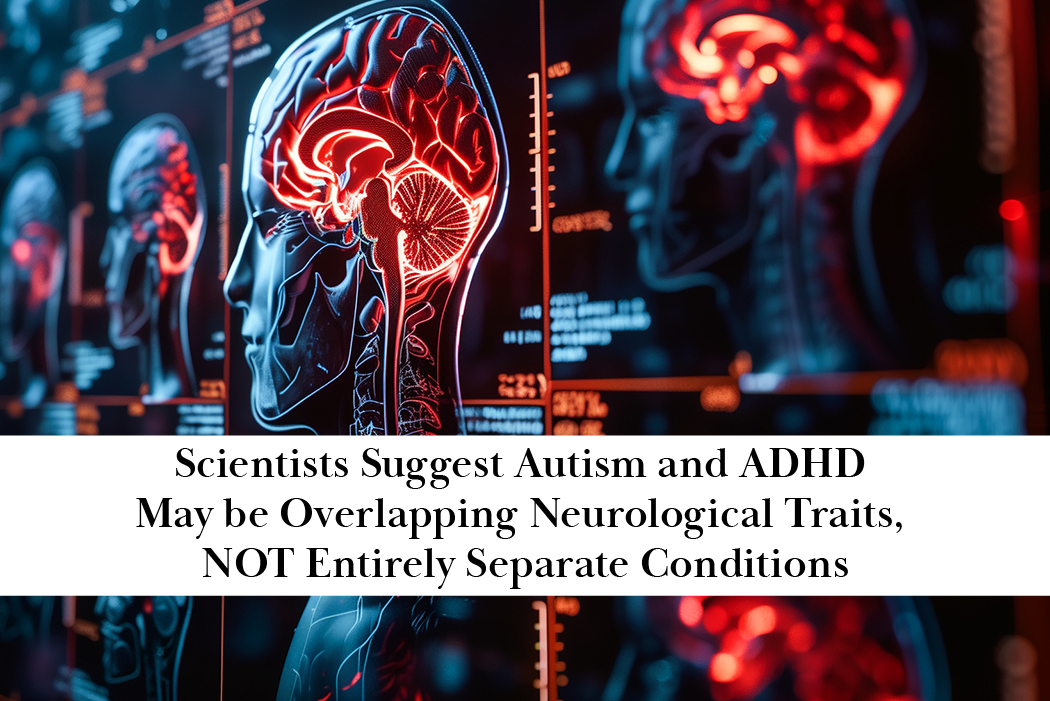
New research is indicating that the connection may be at a biological level. The same brain patterns appear in both children diagnosed with ASD and those diagnosed with ADHD. Researchers analysed brain connectivity in 166 children, ages 6-12. All children were diagnosed with either ASD or ADHD, all were verbal.
Their brain patterns were analysed using a resting-state MRI. This is an non-invasive, brain imaging tool that measures brain activity while the patient simply rests. In the study, children with more pronounced Autistic symptioms showed stronger connections between key brain networks. The main networks showing strong connections were the frontoparietal (FP) and default-mode (DM) systems, which are primarily responsible for social thinking and executive function.
How Development Differs in Autism and ADHD vs. Neurotypical Brains

In neurotypical development, the connections between these networks decrease over time, allowing the brain to specialize. That doesn’t mean that ASD or ADHD people can’t specialize in subjects or focus on tasks, they absolutely can. It simply means that those systems in the brain aren’t specializing in their primary functions in the same way neurotypical brains can. Those functions remain “too busy” in a sense, to provide the consistent, expected response to social stimulation.
Interestingly, these patterns of connectivity were the same, whether the child had an ASD or an ADHD diagnosis. This study allows researchers to focus on specific symptoms more than a diagnosis, giving them a chance to look into the experiences of the people in a way they hadn’t before. We’re not sure, yet, how this research will impact the care and support psychiatrists are able to offer people with ADHD and ASD, but there are a few key areas to build on.
Related Article: Down Syndrome Day 2026 – Celebrating Superstars in Our Community
Key Findings
Some of the key findings from this study are related to a multi-dimensional model of care. That means spending more time understanding how neurodivergent brains mature and develop. People with ASD and ADHD often find ways to work with their different brain functions — especially in the social and executive function networks — but that strategy (often called masking) can lead to burnout.
Research is at an early stage right now, but the more we understand how neurodivergent brains want to function, the better we can support them. Instead of working hard to mask behaviors, mental health workers may be able to help neurodivergent people to hone their own skills.
Knowing that shared clinical traits between ASD and ADHD people are associated with overlapping genetic mechanisms could help psychiatrists to improve the actual symptoms, no matter the label that comes with those symptoms.
Related Article: How Psilocybin “Magic Mushrooms” can Help to Alleviate Mental and Emotional Disorders
The Genetic Concern
Of course, any testing that links ASD and ADHD to genetics also brings up a cause for concern. Differences in connectivity correspond with regions where genes involved in brain development are active. While that’s a great insight in working with ASD and ADHD people, it also gives some researchers something new to worry about. How genetic are these neurodivergencies, and if parents can begin testing for them in utero, will ASD and ADHD people be screened out in genetic testing prior to birth?
The fact that this research will guide future efforts to identify biomarkers and understand vulnerability to autism could be very helpful, or it could become a danger. At a time where fertility rates are low, and the medical industry is already screening for other challenges, associating Autism and ADHD with genetic mechanisms could lead to yet another erasure of Autistic and ADHD people. And, while neurodivergent people can be a challenge to raise, they are also infinitely valuable to our society.
It’s important, when delving deeper into the connections within the human body, to keep the person foremost in our thoughts. “How can this research help these individuals?” and also, “How can we mitigate any harm this might cause?”.
For a long time, medical professionals in both mental and physical health have spent a lot of time diagnosing disorders and diseases and then treating those disorders. But this research is a a reminder that often, it’s the symptoms themselves we should be focusing on.
Symptoms affect individual people. This research shows us that neurodivergent people — too often portrayed as unable to connect socially — are, in fact, full of connections. It begins to give us a roadmap towards supporting our neurodivergent friends and family members.
Featured image © Elena Svetleyshaya via Dreamstime