
One of the most exciting things about scientific theories is that they’re always being upended by new information. Theories are what make up most of the scientific understanding of the world. Essentially, scientists come up with hypotheses to explain and understand the data that they can see and record. Those theories are then continually re-examined and fine-tuned whenever new data comes to light.
Science is full of theories that are constantly evolving, whether they center around human-driven climate change, evolution through natural selection, or the big bang. When new data comes along to challenge our understanding of a theory, scientists are pretty excited. They love new ideas and new information — that’s that whole point of pursuing science. It’s as if the world has pulled out a wrapped gift, saying “but wait, there’s more!”.
That’s exactly what happened in the paleontology world recently when they discovered an exciting link between two different mammoth species. It turns out Woolly Mammoths and Columbian Mammoths may not be as distinct as previously thought. In fact, they may have interbred for millennia.
Meet the Mammoths
During the last Ice Age, two different species of Mammoths roamed the North American continent. In the far north, Woolly Mammoth, an older species adapted to the glacial colds of what is now Canada. In the warmer, southern areas of North America, the Columbian Mammoths arose later in the Pliestocene era. Larger than Woolly Mammoths and much less woolly, Columbian Mammoths adapted to a different climate and environment.
Woolly Mammoths are one of the most commonly depicted animals in ice age art. Along with horses and bison, images of Woollies are common in cave paintings and stone sculptures.
Despite being one of the last Mammoth species, there are fewer records of iteractions between Columbian mammoths and humans. This may be because they developed in an area that didn’t preserve materials as well, or because they simply didn’t interact with humans as often. Columbian mammoths were noticeably larger than Woolly Mammoths. They had larger ears, and longer legs.
For years, paleontologists assumed that these two Mammoth species didn’t interact much. But discoveries of two different molars with mingled DNA tells a different story. Not only did these two species interact, they interbred – producing a healthy, fertile hybrid Mammoth.
Why is the Concept of Species Hybridization so Controversial?
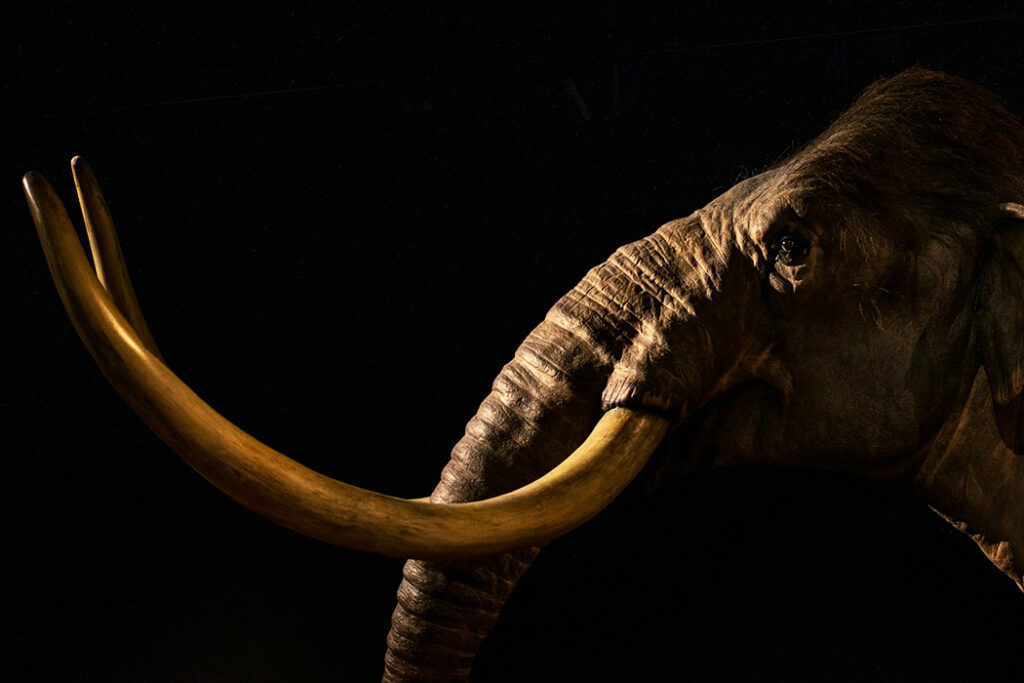
Why is this important? After all, they’re both mammoths — who cares if they can interbreed? Well, this little tidbit of information opens up a lot of information about these two extinct species. For example, what does this kind of cross species-hybridization mean?
An Uncommon Occurance
A genetic hybrid is the offspring of two different species. To create viable offspring, the two species must have enough genetic similarities for a healthy offspring to develop and survive. Often, these hybrids, while healthy, are infertile. Usually, infertile offspring are the result of chromosomal differences in the parents. For example, mules are a healthy hybrid of donkeys and horses. But mules are infertile. In order to create more mules, you have to go back to the parent species again.
Some of the healthiest and most sustainable hybrids exist in the canine family. Among canines, healthy, fertile offspring can come from a variety of species. In fact, canine hybrids are relatively common throughout the world.
For example, eastern coyotes in the United States are larger than typical coyotes. They also live in familial packs like their wolf cousins. Scientists studying the genetics of eastern coyotes have found a mingling of genetics, with the eastern coyotes showing only about 60 percent coyote genes. The other 40 percent of their genetic makeup comes primarily from wolves, with a small amount of domestic dog DNA as well. Interestingly, Eastern coyotes in urban areas have a higher percentage of domestic dog DNA, while coyotes in the rural woodlands of New England have a higher wolf content.
The mingling of genetics in eastern coyotes has enabled these canines to thrive in a changing environment. They’re larger, stronger, and more social than coyotes; more adaptable than wolves, and more comfortable around humans than either coyotes or wolves because of hybridization.
Hybrid Mammoths
Like modern-day canines, prehistoric mammoths seem to have been cross-breeding successfully for a long time. This tells us that prehistoric mammoths have a lot more in common than modern-day African and Asian elephants. African and Asian elephants cannot produce viable offspring, but for millennia prehistoric mammoths were interbreeding with success.
The two hybrid molars discovered have different amounts of shared DNA. The older molar is about 79 percent Woolly Mammoth and 21 percent Columbian; the younger molar has more Columbian DNA – about 35 percent. These numbers show that interbreding what relatively common among North American Mammoths, and that the hybrid offspring were fertile.
A hybrid mammoth with between 20-35 percent Columbian DNA would possibly have a grandparent or two who were genetically about half Columbian and half Woolly. Or, like modern-day eastern coyotes, a genetic history so mixed with interbreeding that it’s almost impossible to deconstruct.
Krestovka Mammoths
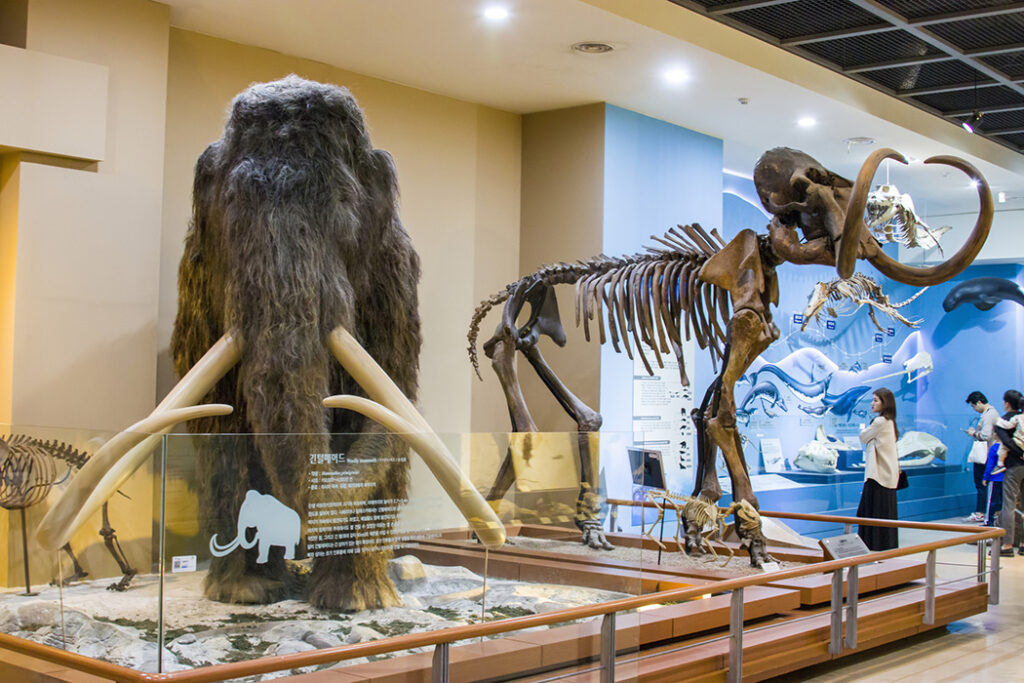
Another interesting link in the chain is the discovery in 2021 of a mammoth tooth in Krestovka, Siberia indicating that the development of various mammoth species is complex and intermingled.
Historically, paleontologists theorized that the older Steppe Mammoths gradually evolved into Woolly Mammoths around 70,000 years ago. But in 2021, they were able to extract DNA from a tooth over a million years old that indicated Woolly Mammoths may have developed seperately from the original Steppe Mammoths earlier than we’d thought. Then, the new species possibly bred back to Steppe Mammoths later, creating a distinct variety of Mammoths, the Krestovka Mammoths.
From there, paleontologists are still theorizing. But it’s possible that long-term hybridization is a more important factor in evolution than previously thought. Remember, most hybrids we see now are less able to thrive in the wild than non-hybrids. But not all. Perhaps Mammoths, like modern-day canines, didn’t just slowly evolve to fit their environment, but hybridized to thrive.
That theory goes against some standard theories of evolution. But that’s the joy of scientific discovery. Theories shift and change like the world they’re built to understand. Nothing is forever set in stone.
Featured image by Bruno Martins, via Unsplash creative commons