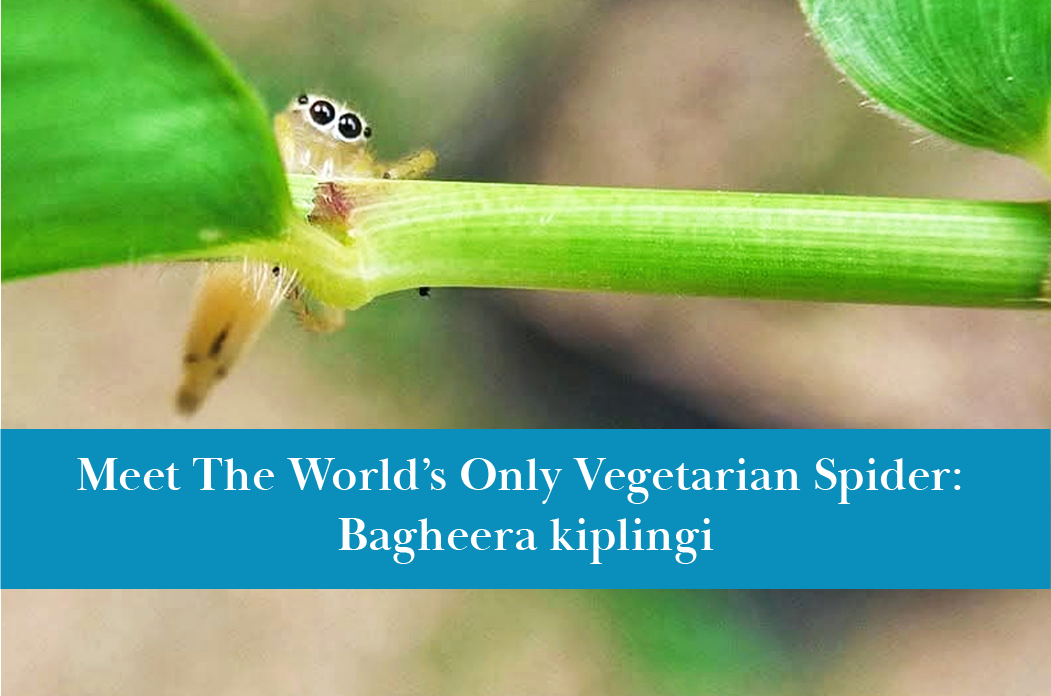
Spiders loom large in the human imagination. Despite their small size, these creatures fascinate us. They haunt us. These tiny predators suck the life out of their victims, and their meal habits disturb us. But if we look more closely at the world, even spiders start to surprise us. Far from being an unified family of carnivores, spiders throughout the world consume varying quantities of meat. One species in particular, however, is almost exclusively vegetarian: the Bagheera kiplingi, named after the panther in Rudyard Kipling’s “The Jungle Book”.
A Spider that Eats Vegetables?
While most species of spider are pure carnivores (like cats and dolphins), some jumping and orb-weaving spiders prefer to supplement their meats with vegetation. These spiders consume insects, but also nectar, pollen and honeydew. For most of these spiders, plant-based foods rarely make up more than a third of the diet. But for the Bagheera kiplingi of Mexico, plant-based foods make up about 90 percent of their diet, only occasionally supplemented by ant larvae, flies, and other spiders.
The Bagheera kiplingi that’s native to Mexico is the only known spider species to pursue a primarily vegetarian diet. Even other Bagheera kiplingi spiders in nearby Costa Rica have a diet that consists of 60 percent plant-based foods. So is this a lifestyle choice for this spider, or a biological imperative?
And what on earth are they eating?
Beltian Bodies and the Bagheera Kiplingi

Bagheera kiplingi is a variety of jumping spider, which are known for their intelligence, friendliness, and problem solving. Jumping spiders make up about 13 percent of spiders worldwide — the largest family of spiders. They’re also smaller than you’d expect: the largest species has only an inch-long body, and the smallest are quite tiny. But they’re curious, clever, and engaging. Jumping spiders have been known to figure out mazes, recognize people, and remember specifics about their environment.
Because of their friendliness and adaptability, jumping spiders make popular pets. They’re even known to “wave” at their favorite people: a gesture that seems to show curiosity and welcome. It makes sense that an adaptable jumping spider species would be the one to explore a new way of living.
Our Bagheera kiplingi friends live in swollen-thorn acacia trees in the forests of Mexico. These trees are essential to supporting its vegetarian lifestyle. This is because these trees produce Beltian bodies: sugar- and protein-rich nodules that grow on the acacia leaves. Unlike the rest of their brethren, B. kiplingi prefers to jump away from insects and towards these nutrient-dense plant structures instead.
What Are Beltian Bodies?
Beltian bodies are fascinating structures. They’re highly nutritious nodules that grow on swollen thorn acacia trees. But acacias only produce them when they’re hosting a colony of wasp-like, arboreal Pseudomyrmex ants. Quite simply, acacia trees without ants don’t produce Beltian bodies. So, what’s the relationship here?
Swollen-thorn acacia trees and Pseudomyrmex ants have a mutually beneficial relationship. These stinging ants make their homes in the acacia trees, living in hollow thorns and feeding on the tree’s abundant Beltian bodies. While living in the trees, the ants protect it from both other insects and larger herbivores. Essentially, these stinging ants patrol the tree and attack the hungry forest pests that would love to devour the trees’ bark and leaves.
The ants’ stings can be very painful, and their venom can cause painful reactions in humans and animals alike. Since they work as a colony, they can attack in groups — driving away herbivores many times their size. The trees produce Beltian bodies to nourish their guardian ants, and our sneaky Bagheera kiplingi spider pals have found a way to benefit from that symbiotic relationship.
Related Article: The yeast-powered breakthrough that could rescue honeybees from collapse
Bagheera kiplingi are Shy, Conflict-Avoidant Spiders
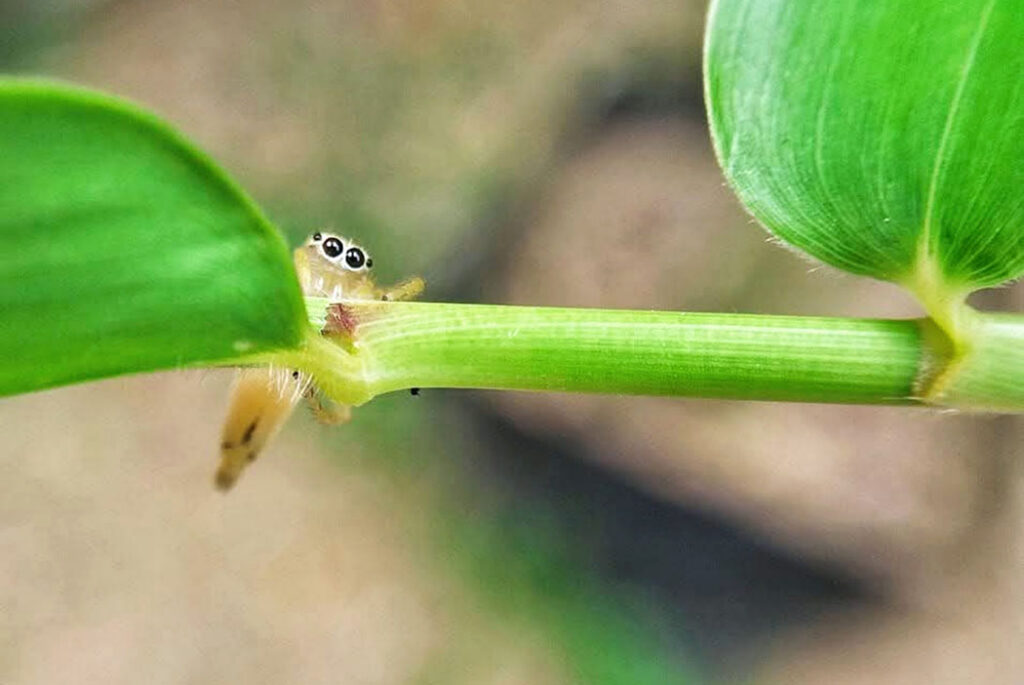
These little spiders build tiny nests for themselves on the far tips of old leaves and try to avoid the patrolling ants. Instead of constructing webs, they use their spider silk to drop out of sight when approached by guarding ants. Quite simply, they don’t want to cause trouble, and they don’t want to fight. They just want to eat some nodules and enjoy a peaceful life.
As a jumping spider, B. kiplingi can also use their strong hind legs to leap away from potential danger. Instead of jumping onto prey, he uses them to avoid aggression: a surprising choice for nature’s perfect predator. Researchers have noted that this species uses the jumping spider’s natural, impressive awareness of its environment to avoid patrolling ants and escape when pursued. Pseudomyrmex ants are very small as well, but their sharp sting is painful. In fact, that sting could be fatal to the B. kiplingi spider, so evasion is very important.
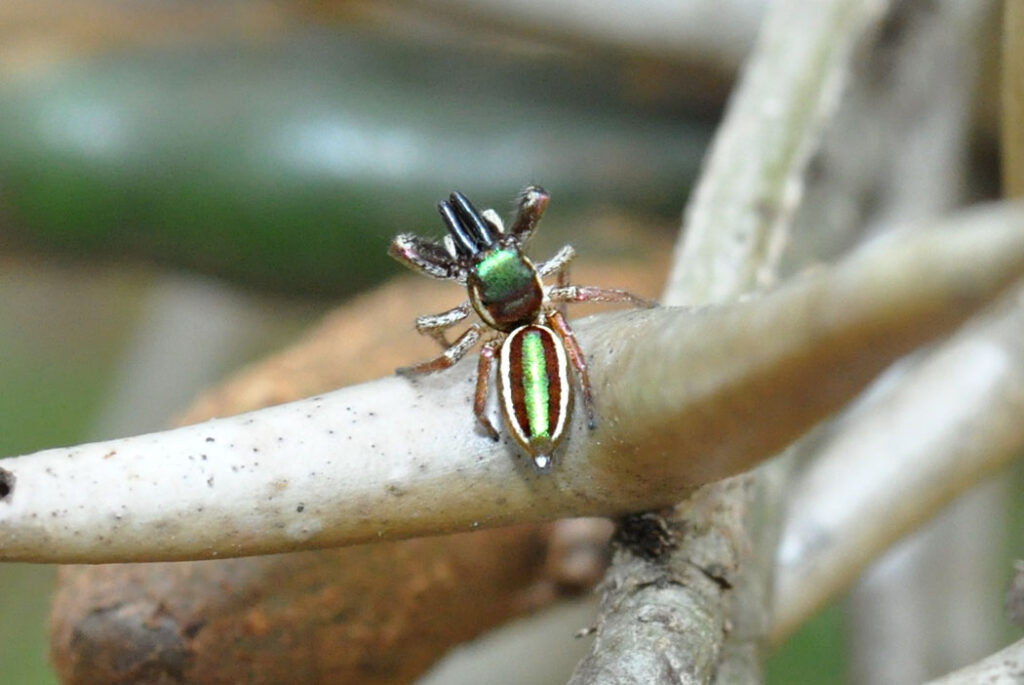
Bagheera kiplingi spiders are small, only about 0.2 inches (or 5mm) long. Their legs are slightly translucent, and are normally brownish yellow to light yellow in color. Their cephalothorax — which is the combined head and thorax of spiders — varies based on sex. For example, male B. kiplingis have a dark green and red colored cephalothorax, while females have a black and red coloration. Both have brown-green abdomens, but those of female spiders are significantly wider.
Unique Challenges
While B. kiplingi spiders primarily consume Beltian bodies, they supplements their diet with nectar and ant larvae. The ant larvae (and very rarely, other spiders as well) keep the spiders from being purely herbivorous. But scientists who have analyzed this spider’s body composition have found that it contains isotopic signatures similar to other herbivores, meaning that eating any animal-based foods is quite a rare occurrence.
What scientists can’t figure out, however, is how these creatures process the high fiber content of Beltian bodies. Like many primarily carnivorous animals, a spider’s digestive system isn’t designed to digest highfiber foods. Most spiders eat by liquifying their prey and then sucking it into their bodies. But the digestive process of Bagheera kiplingi is still a bit of a mystery to us. However they’re consuming their food, they’re thriving on their vegetarian diet.
It’s interesting to note that Mexican B. kiplingi spiders, who have greater access to acacia trees, are barely eating anything besides plant-based foods, while their cousins in Costa Rica, with less access to acacia trees, have to settle for a more omnivorous diet. Interestingly, both species seem to prefer eating Beltian bodies to other forms of food.
Building Community in Acacia Trees
Most spiders are solitary beings. In fact, only about 23 out of over 45,000 species of spider are considered “quasisocial“. Creatures who fall into this category show signs of working together, such as caring for young and occasionally hunting together. It should be no surprise that the world’s only primarily vegetarian spider is also one of the few quasisocial spider species around.
Bagheera are territorial spiders that prefer to be largely left alone, including when gathering food. Like most introverts, however, they have a soft side for their community as well. The females have been spotted guarding hatchlings and egg clutches, and also seem to share space well with each other. Some acacia trees in Mexico have several hundred tiny, vegetarian spiders making a home together. It would appear that B. kiplingi spiders are willing to respect each other’s privacy and live in relative harmony on their trees.
Animals are continually surprising us. Sometimes, even animals we think are simple killers turn out to be good-natured, introverted vegetarians. This is one of the many reasons why getting to know our tiny companions on earth can help us better understand the planet, and ourselves. 1 in 45,000 spider species is vegetarian. 23 species out of those 45,000 are living quasi-social lives. Has the adaptable jumping spider adapted into these behaviors to better thrive in his environment? And if a spider can adapt to thrive in his environment, can we?
Featured image © nur atika, via Dreamstime.com
Additional images by Wayne Maddison and Maximilian Paradiz, via Wikimedia Commons, CC license 3.0., and 2.0, and ©nur atika | Dreamstime.com